
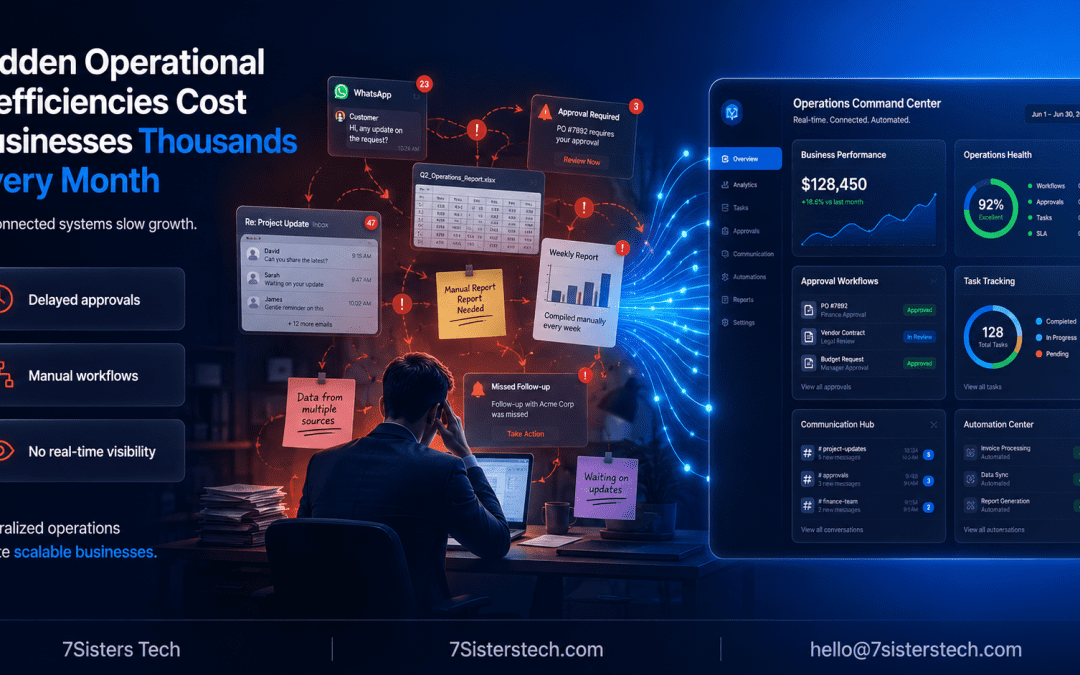
At first, these issues seem manageable. Teams approve requests through WhatsApp messages. Employees update spreadsheets manually. Managers follow up through emails and calls. However, once a business starts scaling, those disconnected workflows begin creating delays, confusion, and unnecessary operational costs.
Consequently, productivity drops while management struggles to identify the real problem.
The Real Cost of Operational Inefficiency
Many growing businesses rely on multiple tools that do not communicate properly. As a result, teams spend valuable hours switching between systems, searching for information, and repeating the same tasks.
According to industry research, employees can lose nearly 20% of their workweek searching for internal information or coordinating across disconnected systems.
In many organizations, teams:
- enter duplicate data repeatedly
- wait hours or days for approvals
- depend on outdated reports
- struggle with poor process visibility
- rely heavily on manual coordination
Although these problems appear operational, they directly impact profitability and growth.
For example, delayed approvals can slow invoicing cycles. Similarly, fragmented reporting often affects decision-making accuracy. Meanwhile, communication gaps create customer service issues and internal frustration.
Over time, those small inefficiencies turn into significant financial losses.
Why Operational Chaos Becomes Worse During Growth
Small teams can temporarily survive inefficient processes. Nevertheless, scaling businesses cannot operate effectively without structured systems.
As organizations grow, operational complexity increases rapidly. More employees, more clients, and more workflows create additional pressure on existing processes. Unfortunately, disconnected software tools rarely scale efficiently.
Because of this, businesses start experiencing:
- operational bottlenecks
- reporting inconsistencies
- delayed approvals
- communication breakdowns
- reduced accountability
- slower decision-making
Eventually, leadership teams spend more time managing operational confusion than focusing on business growth.
Why Modern Businesses Are Centralizing Operations
Today, many companies are moving away from fragmented workflows and adopting centralized operational systems instead.
Rather than using disconnected tools for every department, businesses now prioritize workflow visibility, automation, and unified data management.
Modern operational systems help organizations:
- automate repetitive workflows
- reduce manual errors
- improve approval speed
- centralize business data
- track operations in real time
- improve team productivity
More importantly, centralized systems improve operational clarity across the entire organization.
When leadership gains real-time visibility into workflows and performance, decision-making becomes significantly faster and more reliable.
Note: Operational efficiency impact varies based on company size, workflow complexity, software infrastructure, and team processes. The examples discussed in this article reflect common operational patterns observed across growing businesses.
Final Thoughts
Operational inefficiencies rarely appear as one large problem. Instead, they quietly reduce productivity, increase management overhead, and create invisible financial losses every month.
Therefore, businesses that want sustainable growth must evaluate whether their current workflows truly support scalability.
The companies that grow successfully in 2026 will not simply use more software. Instead, they will build smarter operational systems that improve visibility, automation, and execution speed.
At 7Sisters Tech, we help businesses modernize workflows, centralize operations, and build scalable digital systems designed for long-term growth.
If your team still relies on disconnected tools, manual approvals, or spreadsheet-heavy operations, now is the right time to evaluate where operational inefficiencies may already be slowing your business down.
About 7Sisters Tech
7Sisters Tech specializes in building custom AI workflows, SaaS platforms, and business automation software for companies across the USA, Canada, and beyond. We’ve helped companies transition from fragmented SaaS stacks to unified custom systems. We understand the specific challenges of consolidating data across systems, automating complex workflows, and building software your team actually enjoys using.