
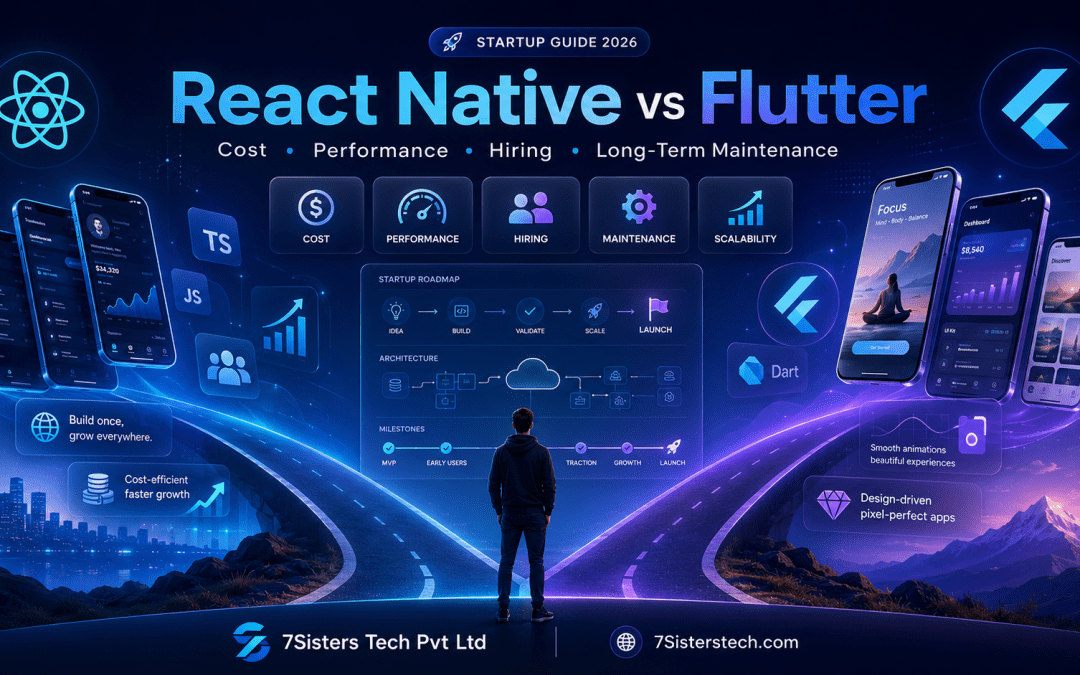
One of the biggest decisions startup founders face is choosing between React Native vs Flutter.
Both frameworks allow developers to build Android and iOS applications using a single codebase. Both are used by startups and enterprises worldwide. However, they differ significantly in developer availability, development speed, performance, ecosystem maturity, and total cost of ownership.
If you’re planning to launch an MVP, build a SaaS mobile product, or create a scalable business application in 2026, this guide will help you make the right decision.
What Is React Native?
React Native is an open-source framework developed by Meta. In addition, it allows developers to build Android and iOS apps from a single codebase. As a result, startups can reduce development time and costs.
Instead of maintaining separate Android and iOS codebases, developers can write most of the application once and deploy it across both platforms.
Popular companies using React Native include:
- Shopify
- Discord
- Coinbase
- Bloomberg
Because JavaScript remains one of the world’s most widely used programming languages, React Native benefits from a massive developer ecosystem.
What Is Flutter?
Flutter is Google’s UI toolkit for building applications from a single codebase. Moreover, it offers extensive UI customization options. Therefore, many companies choose Flutter for visually rich applications.
Flutter uses the Dart programming language and renders its own UI components rather than relying on native platform components.
Popular companies using Flutter include:
- Google Pay
- Alibaba
- BMW
- eBay Motors
- Toyota
Flutter has grown rapidly due to its attractive user interface capabilities and excellent development experience.
React Native vs Flutter
React Native vs Flutter Development Cost
For most startups, development cost becomes the deciding factor.
The framework itself is free. However, developer rates, development time, maintenance effort, and hiring availability significantly affect the overall budget. For example, startups often spend more on hiring than on technology licenses. Consequently, developer availability can significantly affect project budgets.
Typical startup MVP cost
Instead, costs vary because:
- React Native developers are easier to find
- JavaScript developers can transition faster
- Larger talent pool creates competitive pricing
For startups with limited funding, This often provides a slightly lower hiring and development cost.
React Native vs Flutter Performance
Performance is one of the most discussed topics in the React Native vs Flutter debate.
The reality is that for most startup applications, users will not notice a significant difference.
React Native Performance
React Native uses native components and communicates with platform APIs through bridges and optimized architecture layers.
Modern React Native applications can achieve:
Furthermore, performance improvements introduced in recent releases have narrowed the gap with native development. As a result, many business applications run smoothly on React Native.
- Smooth scrolling
- Fast navigation
- Excellent responsiveness
- Near-native performance
Most business applications perform exceptionally well using React Native.
Examples include:
- CRM applications
- SaaS platforms
- E-commerce apps
- Booking applications
- Healthcare applications
- Business automation tools
Flutter Performance
Flutter compiles directly to native machine code and controls its rendering engine. In contrast, Flutter controls its own rendering engine. Therefore, developers gain greater consistency across devices.
Advantages include:
- Consistent UI rendering
- High frame rates
- Smooth animations
- Strong graphical performance
Flutter is particularly attractive for applications requiring:
- Custom animations
- Complex visual interfaces
- Advanced gaming experiences
- Highly customized designs
Hiring Developers: React Native vs Flutter
Hiring flexibility is often underestimated by startup founders. However, recruitment challenges can delay product launches. Therefore, talent availability should be evaluated before selecting a framework.
However, it becomes extremely important when scaling a product team.
React Native Hiring Market
Benefits include:
- Massive JavaScript developer pool
- Easier recruitment
- Lower hiring costs
- Faster onboarding
- Larger agency ecosystem
Since many web developers already work with React and JavaScript, expanding your team becomes easier.
This significantly reduces recruitment risks.
Flutter Hiring Market
Flutter talent continues growing globally.
However:
- Dart remains less common
- Smaller talent pool
- Recruitment may take longer
- Specialized expertise often costs more
While this gap continues shrinking, React Native currently offers greater hiring flexibility in most countries.
Startup MVP Development: Which Framework Wins?
Most startups initially focus on speed, budget, and market validation. Consequently, framework selection becomes a critical business decision. For this reason, many founders compare React Native and Flutter before beginning development.
- Speed to market
- Cost efficiency
- Product validation
- Investor readiness
For these goals, React Native often has an advantage.
Reasons include:
Several factors contribute to React Native’s popularity among startups. First, hiring developers is usually faster. Second, development costs are often lower because of the larger talent pool. Furthermore, the ecosystem is mature and well-supported. Finally, scaling development teams becomes easier as products grow.
For startup MVPs where rapid validation matters, React Native remains one of the strongest choices available.
UI and Design Flexibility
Flutter excels when highly customized interfaces are required.
Advantages include:
- Pixel-perfect designs
- Consistent UI across platforms
- Advanced animation support
- Complete control over rendering
If design uniqueness is a major competitive differentiator, Flutter deserves serious consideration.
Third-Party Integrations and Ecosystem
Modern applications rely heavily on integrations. For example, startups frequently connect payment gateways, CRMs, analytics tools, and AI services. Therefore, ecosystem maturity can reduce implementation risks.
React Native currently benefits from a larger plugin ecosystem. In addition, many integrations have been tested extensively in production environments. Furthermore, the community provides a vast collection of tutorials and resources. Therefore, troubleshooting and implementation are often faster for development teams.
For startups requiring multiple external integrations, React Native frequently reduces implementation effort.
Long-Term Maintenance Comparison
The cost of maintaining an application often exceeds the initial development cost. Therefore, founders should evaluate maintenance requirements early. In addition, developer availability affects future support costs.
Important maintenance factors include:
- Framework updates
- Security patches
- Library compatibility
- Developer availability
- Bug fixes
- Feature enhancements
- React Native Maintenance
Advantages:
React Native offers several maintenance advantages. First, it benefits from a large global developer community. In addition, finding replacement developers is generally easier. Furthermore, extensive documentation helps teams solve problems quickly. As a result, businesses often experience lower long-term operational risk.
Result:
Lower long-term operational risk.
Flutter Maintenance
Advantages:
Flutter also provides important maintenance benefits. For example, its rendering architecture remains highly consistent across platforms. Moreover, developers have greater control over UI behavior. However, the available talent pool is smaller than React Native’s. Consequently, recruiting replacement developers may take longer in some markets.
Challenges:
- Smaller developer pool
- Less flexibility in recruiting replacement developers
For startups expecting frequent team changes, React Native often provides greater operational stability.
When Should Startups Choose React Native?
React Native is ideal when:
- Budget constraints are a major concern.
- Additionally, a fast MVP launch is required.
- Furthermore, hiring flexibility is important for future scaling.
- If your team already has React experience, development can move faster.
- Moreover, React Native works exceptionally well for business applications.
- As a result, startups can iterate and release updates more efficiently.
Typical use cases:
- SaaS products
- CRM systems
- Marketplace apps
- Healthcare platforms
- Delivery apps
- Service booking apps
- Business management solutions
When Should Startups Choose Flutter?
Flutter is ideal when:
- Highly customized user interfaces are critical.
- In addition, advanced animations are required.
- For many consumer-focused products, visual branding plays an important role.
- Furthermore, Flutter provides consistent rendering across different devices.
- If your team already works with Dart, onboarding becomes easier.
Typical use cases:
- Design-heavy applications
- Consumer-focused products
- Interactive applications
- Media-rich experiences
- Custom visual platforms
React Native vs Flutter: Which Framework Is Better in 2026?
There is no universal winner. Instead, the right choice depends on your product goals, budget, and hiring strategy. However, React Native generally offers broader developer availability. On the other hand, Flutter provides greater control over UI customization.
The right choice depends on your business objectives.
For most startups focused on:
- Launching quickly
- Reducing costs
- Hiring efficiently
- Scaling teams easily
- Building SaaS products
- Creating business applications
React Native often provides the strongest business value.
Flutter remains an excellent choice for startups prioritizing unique user experiences and advanced visual interfaces.
The best framework is ultimately the one that aligns with your budget, product roadmap, hiring strategy, and long-term growth plans.
Frequently Asked Questions
Is React Native better than Flutter for startups?
Is Flutter faster than React Native?
Which framework costs less to develop?
Can React Native and Flutter both build Android and iOS apps?
Which framework is easier to hire developers for?
Ready to Upgrade Your Business?
Choosing between React Native vs Flutter for startups is not just a technical decision, it is a business decision.
Founders should evaluate:
- Budget
- Development speed
- Hiring availability
- Product complexity
- Maintenance requirements
- Future scalability
For many startups in 2026, React Native offers an attractive balance of cost efficiency, scalability, and developer availability. However, Flutter remains an excellent option for products that require highly customized user experiences. Therefore, founders should evaluate both immediate business needs and long-term growth plans before making a decision. Ultimately, the best framework is the one that aligns with your product vision, budget, and hiring strategy.
If you’re planning a mobile application and need guidance on selecting the right technology stack, discussing your product goals with an experienced development team before development begins can save significant time, money, and future technical debt.
Planning a startup app? Contact 7Sisters Tech for a free consultation and receive a realistic estimate, technology recommendation, and roadmap tailored to your business goals.
📞 Call Us: +91 9974123196
📧 Email: hello@7sisterstech.com
💬 WhatsApp:+91 9974123196