
It happens gradually.
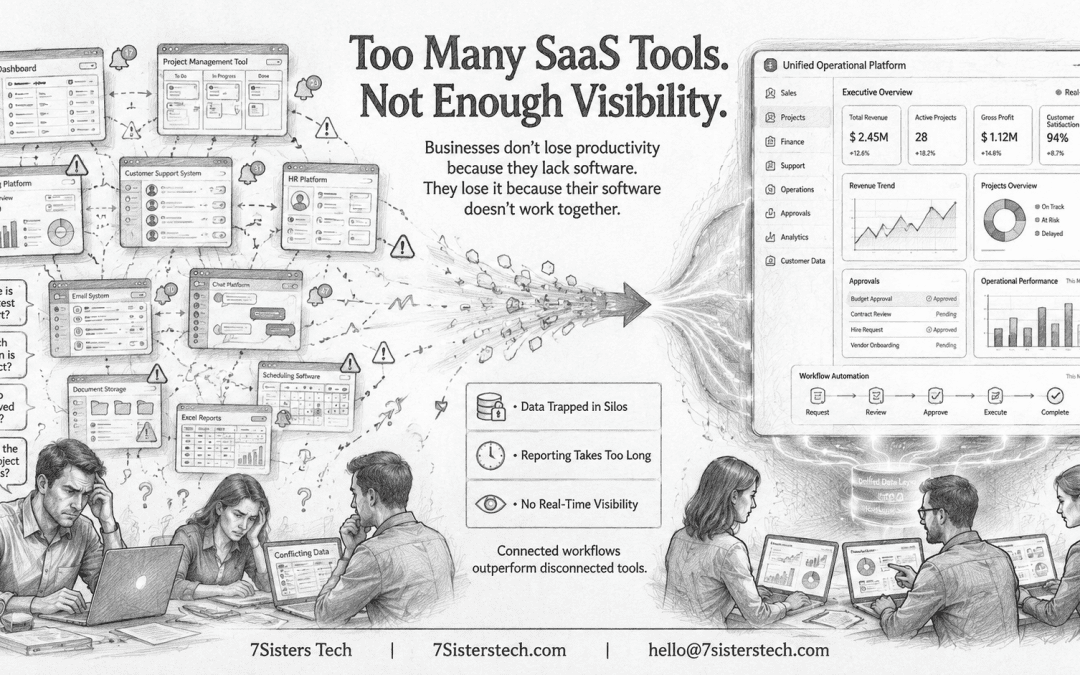
A CRM gets added to improve sales tracking. A project management platform follows. Then comes accounting software, customer support software, HR software, reporting tools, internal chat applications, scheduling platforms, document storage systems, and countless spreadsheets.
Each purchase makes sense on its own.
Collectively, however, they often create a new problem: operational fragmentation.
The irony is simple.
Many growing companies invest heavily in software to improve efficiency. Yet as their technology stack expands, teams spend more time managing systems and less time moving the business forward.
The Hidden Cost Nobody Measures
Software costs are visible.
Operational friction is not.
While executives can easily see monthly SaaS subscriptions on a credit card statement, the cost of fragmented workflows rarely appears on a financial report.
Consider a typical scenario.
A customer requests a project update.
Sales information sits inside the CRM.
Project status lives in a separate task management platform.
Invoices are stored in accounting software.
Customer communication is scattered across email and messaging apps.
As a result, a simple question requires information from four different systems.
The software works.
The business workflow does not.
Consequently, teams spend valuable time searching, verifying, and transferring information instead of making decisions or serving customers.
When Growth Creates Complexity
For startups with five employees, disconnected tools may not create serious challenges.
Once organizations reach twenty, fifty, or one hundred employees, the situation changes dramatically.
Departments begin creating their own processes.
Teams adopt their preferred software.
Managers build spreadsheets to bridge information gaps.
Meanwhile, leadership struggles to answer fundamental questions:
- Which projects are delayed?
- Which customers need attention?
- Where are approvals stuck?
- Which teams are overloaded?
- What is the real operational status of the business?
Without clear visibility, growth creates complexity faster than companies can manage it.
Therefore, the problem is no longer technology adoption.
The problem becomes information fragmentation.
The Four Warning Signs of SaaS Tool Sprawl
1. Teams Enter the Same Data Multiple Times
Moreover, duplicate data entry increases the risk of errors, inconsistencies, and reporting conflicts.
2. Reporting Takes Longer Than Decision-Making
Instead of generating insights, teams become report builders.
3. Approvals Move Through Multiple Channels
As a result, accountability becomes difficult and delays become normal.
4. Leadership Lacks Real-Time Visibility
When executives cannot see accurate business data quickly, strategic decisions become slower and riskier.
The Companies Winning in 2026 Are Doing Something Different
Forward-thinking businesses are shifting away from tool-first thinking.
Instead, they focus on workflow-first thinking.
Rather than asking:
“Which software should we buy next?”
They ask:
“How should information move through our business?”
This change in mindset is significant.
Companies that prioritize connected workflows create environments where sales, operations, finance, customer support, and management work from the same operational reality.
As a result, communication improves.
Reporting becomes faster.
Decision-making accelerates.
Most importantly, growth becomes easier to manage.
Technology Is Not the Competitive Advantage
For years, businesses believed competitive advantage came from adopting more software.
Today, that assumption is becoming outdated.
Most competitors can purchase the same SaaS products.
Few competitors can build highly efficient operational systems.
The organizations gaining an advantage are not necessarily using more tools.
Instead, they are reducing friction between people, processes, and information.
That is where productivity gains occur.
That is where operational excellence emerges.
And increasingly, that is where profitability grows.
Note: Operational efficiency impact varies based on company size, workflow complexity, software infrastructure, and team processes. The examples discussed in this article reflect common operational patterns observed across growing businesses.
Final Thoughts
SaaS tools are not the problem.
Poorly connected workflows are.
As businesses scale, operational complexity grows faster than most leaders expect. Therefore, organizations that continue adding disconnected software often create hidden inefficiencies that slow decision-making, reduce visibility, and increase costs.
The future belongs to businesses that treat technology as a connected operational system rather than a collection of separate tools.
Because in modern organizations, success is no longer determined by how many applications you use.
It is determined by how effectively they work together.
Ready to Evaluate Your Operational Efficiency?
If your team relies on multiple SaaS tools, spreadsheets, and manual processes to manage daily operations, it may be time to assess where information gaps, approval delays, and workflow bottlenecks are slowing growth.
Explore our insights on custom software, workflow automation, and operational systems to discover how modern businesses are building scalable digital infrastructure.