
The business was healthy. Revenue was increasing. New customers were coming in every month.
Yet every Monday morning followed the same pattern.
The sales team had one report. Operations had another. Inventory numbers came from a spreadsheet. Finance worked from a different system altogether.
By the time leadership finished collecting information from every department, half the day was gone.
The surprising part wasn’t the lack of data.
The company had plenty of data.
The real problem was that nobody could see the business in one place.
This is becoming a common challenge for companies between $1 million and $2 million in annual revenue. As organizations grow, information spreads across CRM platforms, accounting systems, spreadsheets, project management tools, and messaging apps. Every department has visibility into its own work, but leadership loses visibility across the business.
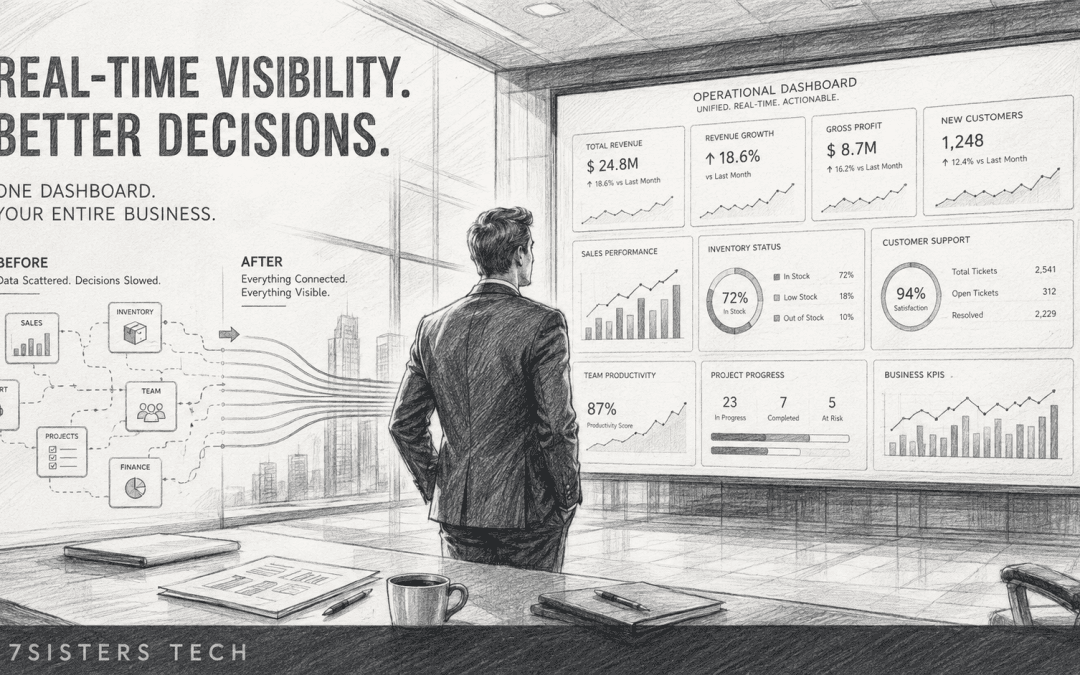
That is exactly why more companies are investing in an operational dashboard for business.
Why Growing Businesses Struggle with Visibility
Most reporting systems were never designed for growing organizations.
A company with five employees can survive on spreadsheets and manual updates. A company with fifty employees usually cannot.
As headcount increases, so does operational complexity. Sales teams track opportunities inside a CRM. Finance teams work from accounting software. Operations teams manage inventory or service delivery through separate platforms. Each system contains valuable information, but none provide a complete picture.
The result is familiar.
Managers spend hours requesting updates. Department heads create manual reports. Leadership meetings become exercises in gathering information rather than making decisions.
In our experience, the issue is rarely a lack of software. More often, businesses have too many disconnected tools and no centralized visibility.
What an Operational Dashboard for Business Actually Solves
Many people think dashboards are simply reporting tools.
That misses the point.
A well-designed operational dashboard helps leadership answer critical business questions without waiting for a report to arrive.
For example:
- Are sales tracking toward monthly targets?
- Which projects are behind schedule?
- Is inventory running below safe levels?
- Which customers require immediate attention?
- Where are operational bottlenecks slowing delivery?
When those answers are available instantly, managers spend less time collecting information and more time acting on it.
That difference becomes increasingly important as a business scales.
A Real Example of Reporting Friction
Consider a manufacturing company handling hundreds of orders each month.
Production data sits inside one system. Inventory records live somewhere else. Customer orders arrive through a CRM. Financial reporting comes from accounting software.
Without a centralized dashboard, leadership often waits until the weekly review meeting to identify problems.
Imagine discovering on Friday that a raw material shortage began on Monday.
The issue is not the shortage itself.
The issue is losing four days before anyone notices.
An operational dashboard changes that dynamic by bringing critical information together in real time.
Key Metrics CEOs Monitor in a Business Dashboard
The best dashboards focus on business outcomes rather than overwhelming users with data.
Most executives care about a small group of metrics:
- Revenue performance
- Sales pipeline value
- Profit margins
- Open customer issues
- Inventory status
- Project delivery progress
- Team productivity
- Cash flow position
The objective is clarity.
When leaders can see these indicators in one place, decision-making becomes faster and more confident.
Build vs Buy: Should Businesses Use Off-the-Shelf Dashboard Software?
Many organizations begin with generic reporting tools.
That approach works when reporting requirements are simple.
However, businesses often discover that their most important information exists across multiple systems. Connecting CRM data, ERP records, inventory information, customer service metrics, and financial reports into a single view can quickly become challenging.
This is where custom dashboard development becomes valuable.
Instead of forcing a business to adapt to software limitations, a custom operational dashboard is built around the company’s actual workflows, reporting needs, and growth objectives.
For businesses managing complex operations, that flexibility often delivers more value than another standalone reporting tool.
Disclaimer: This article is for informational purposes only. The information provided may vary based on business requirements, industry regulations, and project scope. Please consult relevant professionals before making business or technology decisions
Final Thoughts
The companies gaining an advantage today are not necessarily collecting more data than their competitors.
They are making faster decisions because they have better visibility.
If leadership teams still rely on spreadsheets, manual reporting, or weekly status meetings to understand what is happening across the organization, the underlying issue may not be productivity.
It may be visibility.
At 7Sisters Tech, we help businesses build custom operational dashboards that connect CRM systems, ERP platforms, finance tools, inventory systems, and internal workflows into a single source of real-time visibility.
Related Services:
- Custom Software Development
- CRM Development Solutions
- ERP Implementation & Customization
- Business Process Automation
- AI & Workflow Automation Solutions
When business leaders can see what is happening in real time, they spend less time chasing reports and more time moving the company forward.