
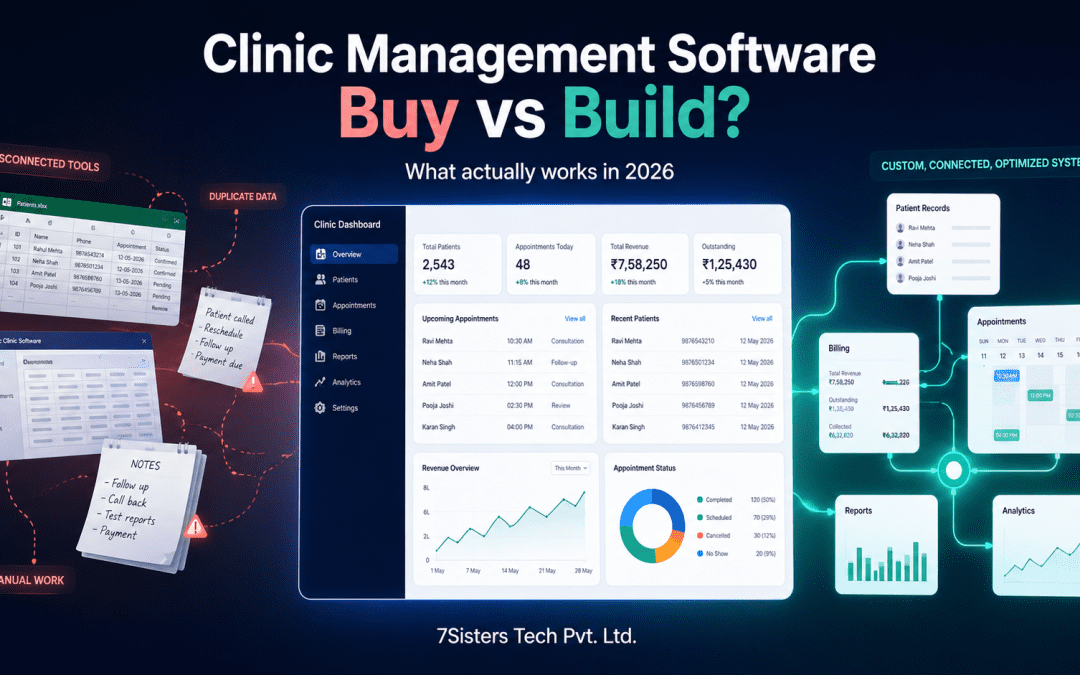
This is not a coincidence. Off-the-shelf clinic management software is built for the average clinic. However, your clinic is not average. It has specific workflows, specific patient demographics, specific billing requirements, and specific staff processes that no generic tool was designed to handle.
This guide is not another “best 10 tools” list. Instead, it is a practical decision framework for US clinic owners and practice managers who want to understand what clinic management software should actually do, when off-the-shelf tools make sense, when custom-built software becomes the better investment, and what both options realistically cost in 2026.
2 hrs
40%
$15K–$60K
HIPAA
What clinic management software actually needs to do
Before evaluating any option off-the-shelf or custom, it helps to be clear on what clinic management software is responsible for. Many clinics purchase tools that handle scheduling well but fail on billing, or handle records well but cannot generate the reports the practice manager actually needs.
A complete clinic management system covers three operational layers. The first is patient management – registration, records, appointment history, prescriptions, lab results, and document storage. The second is scheduling and revenue – appointment booking, automated reminders, insurance eligibility verification, claims submission, billing, and collections. The third is operations – staff scheduling, inventory tracking, performance dashboards, and compliance reporting.
Furthermore, any clinic management software handling Protected Health Information (PHI) in the US must meet HIPAA Security Rule requirements. This includes encrypted data storage, role-based access controls, audit logging, and breach detection capabilities. Therefore, HIPAA compliance is not optional, it is a legal requirement that shapes both what software you choose and how it is built.
Off-the-shelf vs custom clinic management software — the honest comparison
Off-the-shelf software
- Monthly subscription – ongoing cost forever
- Built for generic clinic workflows
- You adapt your processes to fit the tool
- Vendor controls all updates and features
- Limited customisation within the platform
- Integrations often require paid add-ons
- Data portability can be difficult when leaving
- HIPAA compliance depends entirely on vendor
Custom-built software
- One-time development cost – you own it
- Built for your exact clinic workflow
- Software adapts to how your clinic works
- You control every feature and update
- Unlimited customisation as you grow
- Integrates with any system you need
- Full data ownership and portability
- HIPAA compliance built into architecture
Neither option is universally better. However, the right choice depends on where your clinic is in its growth and how closely your workflows match what generic software provides. The next section helps you make that determination.
The hidden cost of off-the-shelf clinic software is not the subscription fee. It is the staff hours spent working around what the software cannot do.
7 signals your clinic has outgrown off-the-shelf software
1. Your staff maintains Excel sheets alongside your software
When your team uses spreadsheets or paper forms to fill gaps in your clinic management system, that is a clear signal the software does not fit your workflow. Additionally, every manual workaround creates data accuracy risk and costs staff time that should be spent on patient care.
2. You are paying for multiple tools that do not talk to each other
One platform for scheduling, another for billing, a third for patient records. Consequently, your staff re-enters data across systems daily. Each data transfer is a source of errors and a source of claim denials. A unified custom system eliminates this entirely.
3. Your reporting does not reflect how your clinic actually measures performance
If you cannot get the specific metrics your practice manager needs without exporting to Excel first, your software is working against you. Custom clinic management software produces the exact dashboards your clinic needs – nothing more, nothing less.
4. Your specialty has workflows that generic software handles poorly
Orthopedics, behavioral health, cardiology, physical therapy, urgent care – each specialty has billing codes, documentation requirements, and clinical workflows that differ significantly from a general practice. Therefore, generic clinic software forces compromises that specialty practices cannot afford.
5. You are opening multiple locations or adding providers
Scaling a clinic means your software must scale with it. However, off-the-shelf platforms often charge per provider or per location, making costs grow rapidly. Custom software handles multi-location, multi-provider operations without punishing you for growing.
6. Your monthly software subscriptions exceed $1,500 combined
Add up every tool your clinic pays for monthly. For most mid-size practices, this figure reaches $1,500 to $4,000 per month. Over three years, that is $54,000 to $144,000 – often more than a custom system would have cost to build once and own permanently.
7. A vendor has sunset a feature or raised prices significantly
When you depend on off-the-shelf software, you depend on the vendor’s decisions. Price increases, feature removals, and platform shutdowns are beyond your control. In contrast, custom software gives you permanent ownership regardless of what happens in the market.
What custom clinic management software costs in 2026
Cost varies based on the features your clinic needs, whether you require mobile access, and the development team you choose. These ranges reflect what US and Canadian clinics are paying for custom-built clinic management systems in 2026.
Basic clinic system
Patient records, scheduling, basic billing, single location, standard HIPAA setup
Mid-size practice system
Full billing, insurance integration, custom reporting, multi-provider, mobile access
Multi-location platform
Multiple locations, complex workflows, lab integrations, telehealth, advanced compliance
Ongoing maintenance
Annual maintenance of original build cost. Covers updates, security patches, and support
The subscription cost comparison – run this calculation for your clinic
Add your monthly software subscriptions across all tools. Multiply by 36 months. Compare that number to a one-time custom build cost. For many clinics paying $2,000+ per month across multiple platforms, a custom system pays for itself within 2–3 years – and after that, every dollar previously paid in subscriptions stays in your clinic.
HIPAA compliance – what it means for your clinic management software
Any clinic management software that handles patient records, billing information, or appointment data in the US is handling Protected Health Information. As a result, HIPAA compliance is a non-negotiable requirement – not just a feature to look for.
Whether you buy off-the-shelf or build custom, your clinic management software must meet HIPAA Security Rule requirements: encrypted data storage, role-based access controls, tamper-evident audit logs retained for six years, and breach detection capabilities. You must also have a signed Business Associate Agreement (BAA) with every vendor whose software touches patient data. Without a BAA, your clinic is exposed – regardless of how good the software is.
With off-the-shelf software, HIPAA compliance depends entirely on the vendor. Most established platforms offer HIPAA-eligible configurations – however, not all plans at all price tiers include the required features. Always confirm HIPAA eligibility and request a BAA before deploying any clinic management tool with real patient data.
With custom-built software, HIPAA compliance is designed into the architecture from day one. Furthermore, your development partner signs a BAA as part of the engagement, and the audit logging, encryption, and access controls are built specifically for your clinic’s workflow. For a detailed breakdown of what HIPAA compliance requires in software development, read our HIPAA-compliant app development guide for US healthcare startups.
When off-the-shelf clinic software is still the right choice
Custom software is not always the answer. There are situations where established off-the-shelf platforms make more sense and being honest about this matters more than pushing one option.
- Your clinic opened recently and your workflows are still evolving – wait until processes are stable before building custom
- Your needs are genuinely standard, basic scheduling, records, and billing without specialty-specific requirements
- Your monthly subscription cost is under $800 across all tools – the economics do not yet favour a custom build
- You do not have an internal person who can manage a software project and give regular feedback
- You need something operational within 2 weeks – off-the-shelf deploys immediately, custom builds take 10–20 weeks
In these cases, start with off-the-shelf tools and revisit the custom question when your clinic has grown into the limitations. The right time to build custom is when the cost of working around your current software becomes measurable – in staff time, billing errors, or patient experience.
Frequently asked questions about clinic management software
What is clinic management software?
Does clinic management software need to be HIPAA compliant?
How much does clinic management software cost?
What is the difference between clinic management software and EHR?
How long does it take to build custom clinic management software?
Can clinic management software integrate with existing lab or pharmacy systems?
Planning to build or upgrade your clinic management software?
We build custom clinic management systems for US and Canadian healthcare practices – with HIPAA-compliant architecture designed from day one. If you want an honest conversation about what your clinic’s software needs and what it would cost to build, we are happy to talk.
No commitment required. Just a straight conversation.
Book a call: BookaProductStrategyCall@7sisterstech.com
Or email us → hello@7sisterstech.com · WhatsApp us +91 9974123196