
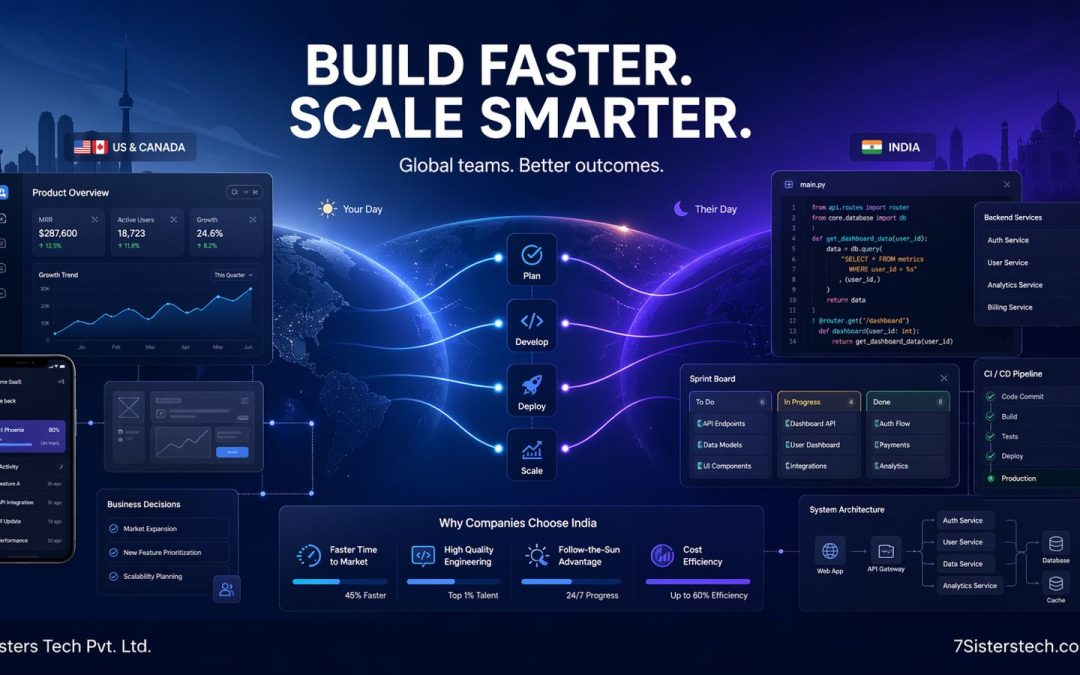
This is why over 70% of US and Canadian companies now outsource software development rather than build fully in-house. And among all offshore destinations, India handles more than 60% of global software outsourcing demand – not because it is the cheapest option, but because it consistently delivers the best combination of technical quality, communication, and cost.
This guide gives US and Canadian founders, CTOs, and business owners the complete picture – why companies outsource software development to India, what it costs, how to choose the right partner, how to structure the engagement, and the mistakes that turn a good outsourcing decision into an expensive one.
70%+
60%
50–70%
1.5M+
Why US and Canadian companies outsource software development to India
The decision to outsource software development is no longer primarily about cost. Research from Deloitte’s Global Outsourcing Survey shows that US companies outsource to improve speed to market and access specialised skills — cost reduction is a significant benefit but rarely the only reason.
For a US or Canadian startup, the case for outsourcing software development to India comes down to three compounding advantages that are difficult to replicate through hiring.
Cost advantage – real numbers
A senior software engineer in the US or Canada charges $100 to $200 per hour as a contractor. An equivalent engineer at an India-based development company charges $25 to $55 per hour. For a project requiring 1,000 development hours, that difference is $75,000 to $145,000 in development cost – on a single project.
USA / Canada
Highest cost. Strong timezone alignment for daily standups.
UK / W. Europe
Good quality. 5–8hr timezone gap from US East Coast.
Eastern Europe
Strong talent. Increasingly competitive with India on cost.
India - Best Value
Same technical quality, 60–70% lower cost. Largest talent pool globally.
Talent depth – not just volume
India produces over 1.5 million engineering graduates every year. However, the more important number is experience depth – Indian software professionals working with US and Canadian clients have been doing so for two decades. They understand product thinking, agile workflows, English-language communication, and the expectations of North American startup teams in ways that newer outsourcing markets simply cannot match.
Execution speed
The 9.5 to 12.5 hour timezone difference between India and the US East Coast – which looks like a disadvantage on paper – functions as a “follow the sun” development model in practice. Consequently, your team in India works while you sleep. You review their output in the morning. In a well-structured engagement, this means your product moves forward every single day without waiting for overlap windows.
Outsourcing software development to India is no longer a cost-cutting tactic. For most US and Canadian startups, it is the fastest path to a well-built product with a development budget that leaves room to grow.
What you can outsource to an India-based development team
The scope of what Indian software development companies handle for US and Canadian clients has expanded significantly. It is no longer limited to simple websites or basic applications.
Product development
- SaaS platform development
- Mobile app development (iOS, Android, React Native)
- Web application development
- MVP development
- Custom software development
- E-commerce platforms
Integrations & systems
- CRM development & integration
- ERP development & customisation
- Third-party API integration
- Payment gateway integration
- Business automation tools
- Data migration projects
Ongoing development
- Dedicated development team
- Feature additions & iteration
- Bug fixes & maintenance
- Performance optimisation
- Security updates
- Infrastructure scaling
The 4 outsourcing models – which one fits your situation
Before evaluating any development partner, US and Canadian companies need to choose the right engagement model. The model you choose affects cost, flexibility, timeline, and how much control you maintain over the product.
Fixed price project
You define the scope upfront. The development company provides a fixed quote. Payments are tied to milestones. Code ownership transfers to you on completion. This works best for well-defined, bounded projects where requirements are unlikely to change significantly. Predictable budget. Less flexible if your requirements evolve.
Dedicated development team
A structured team – typically a tech lead, one or two developers, a designer, and a QA engineer – works exclusively on your product on a monthly retainer.
As a result, this is the most popular model for US and Canadian startups building products that will grow over time. You get consistency, institutional knowledge, and the flexibility to change direction without renegotiating scope.
Time and materials
You pay for hours worked at an agreed hourly rate. Maximum flexibility – scope can change week to week. This works particularly well for products in early exploration stages where requirements are still being validated through user feedback.
Staff augmentation
You add individual Indian developers directly into your existing team. They work under your management, follow your processes, and use your tools. Best when you have an internal tech team that needs specific skills – React Native, AI/ML, DevOps – without the overhead of a full outsourced team structure.
Quick model selector for US & Canadian companies
- Building a defined product for the first time → Fixed price or dedicated team
- Already have a product and need ongoing development → Dedicated team
- Requirements changing rapidly, early stage → Time and materials
- Have an internal team, need specific skills → Staff augmentation
- Not sure which model — always start with a paid discovery phase before committing
How to outsource software development to India: a step-by-step process
1. Define what you are building – before talking to anyone
Write down your product idea, the core problem it solves, who it is for, and the features you need for version one. You do not need a technical specification – you need enough clarity to have a real conversation. Vendors who ask good questions will help you sharpen this. Vendors who immediately send you a proposal without asking questions are showing you who they are.
2. Evaluate vendors on quality signals – not just price
Ask to see live products they have built – not just screenshots. Find out how they handled a project that had a complication. Their discovery process matters too, so ask how long it takes and what it produces. Finally, confirm who owns the IP and what the code handoff looks like.
3. Run a paid discovery phase before committing to full development
A discovery phase – 2 to 4 weeks – produces a technical specification, architecture plan, wireframes, and an accurate cost estimate. In practice, it costs $2,000 to $8,000. As a result, it prevents scope disputes, architecture mistakes, and surprise budget overruns that cost 10x that amount to fix in development.
4. Get the contract right before development starts
Your contract must explicitly cover IP ownership, NDA protection, and data security obligations. Additionally, include milestone-based payments, a clear scope change process, and terms for ending the engagement. A lawyer review costs $500 – far cheaper than a $50,000 dispute later.
5. Set up communication infrastructure from day one
Daily async updates, weekly video standups, a shared project management tool (Jira, Linear, or Notion), and a clear escalation path for blockers. In practice, the companies that get the most from outsourcing to India treat communication discipline as non-negotiable from the first day – not something to figure out as they go.
6. Treat your offshore team as a long-term partner – not a vendor
In fact, the best outsourcing relationships are long-term. Teams that understand your product, your users, and your business make better decisions independently – which speeds up development and reduces the management overhead on your end. The companies that get the worst results from outsourcing are the ones who treat every engagement as a one-off transaction.
What outsourcing software development to India costs in 2026
Cost varies significantly based on team size, engagement model, project complexity, and the specific company you work with. These are the real ranges US and Canadian companies pay when outsourcing to India in 2026.
Simple web or mobile app
Basic features, standard workflows, 8–12 week build
SaaS MVP
Core product, auth, dashboard, 1–2 integrations, 10–14 weeks
Full SaaS platform
Multiple modules, polished UX, integrations, 4–7 months
Dedicated team monthly
3–5 person team, ongoing development, flexible scope
For context – the same SaaS platform that costs $40,000 to $120,000 with an India-based team typically costs $150,000 to $350,000 with a US-based agency. Ultimately, the output is the same. The difference is entirely in where the team is located and what their market costs.
5 mistakes US and Canadian companies make when outsourcing to India
Choosing based on price alone
The cheapest quote is almost never the best value. For example, a team that builds your product incorrectly for $15,000 costs $60,000 to rebuild. Evaluate on experience, communication quality, and discovery process – not the bottom of the price range.
Starting development without a discovery phase
Jumping straight from “here’s my idea” to “start building” without proper scoping is how projects become 40% over budget and 60% over timeline. Therefore, always run a discovery phase first. The cost is minimal compared to what it prevents.
Not clarifying IP ownership upfront
Every contract must state explicitly that you own 100% of the code, designs, and intellectual property produced during the engagement. Without this clause clearly written, ownership becomes legally ambiguou, Furthermore, that ambiguity is expensive to resolve.
Treating the offshore team as order-takers
The best India-based development teams have strong technical opinions. As a result, founders who ignore developer input on architecture and implementation decisions consistently end up with systems that work initially but are expensive to scale. Listen to your technical team – that is why you hired them.
No internal point of contact on your side
Outsourcing does not mean handing off and disappearing. Every successful offshore engagement has a committed person on the client side who manages feedback, makes product decisions, and keeps the team unblocked. Without this, development slows to a fraction of its potential pace.
What to look for in an India-based software development company
There are thousands of software development companies in India. However, the difference between a great partner and a disappointing one is almost always visible before you sign – if you know what to look for.
Questions to ask every vendor you evaluate
- Can I see and use live products you have built for US or Canadian clients?
- How do you handle a project where requirements change significantly mid-build?
- What does your discovery process look like and how long does it take?
- Who owns the code and IP at the end of the engagement?
- What is your process when a developer leaves the team mid-project?
- How do you manage timezone differences for US client communication?
- Can I speak with a past client whose project had a complication?
A development company that answers these questions with specificity and confidence has worked with US and Canadian clients before. On the other hand, one that gives vague or defensive answers has not – or has not done it well.
Ready to outsource your software development project?
We are a software development company based in India working with startups and business owners across the US, Canada, UK, and Australia. We build SaaS platforms, mobile apps, custom software, and CRM systems — with a development process designed specifically for North American clients.
If you want a straight conversation about what your product will take to build, what it will cost, and how we work — book a free 30-minute call. No pitch. Just answers.
Book a call: BookaProductStrategyCall@7sisterstech.com
Or email us → hello@7sisterstech.com · WhatsApp us +91 9974123196