
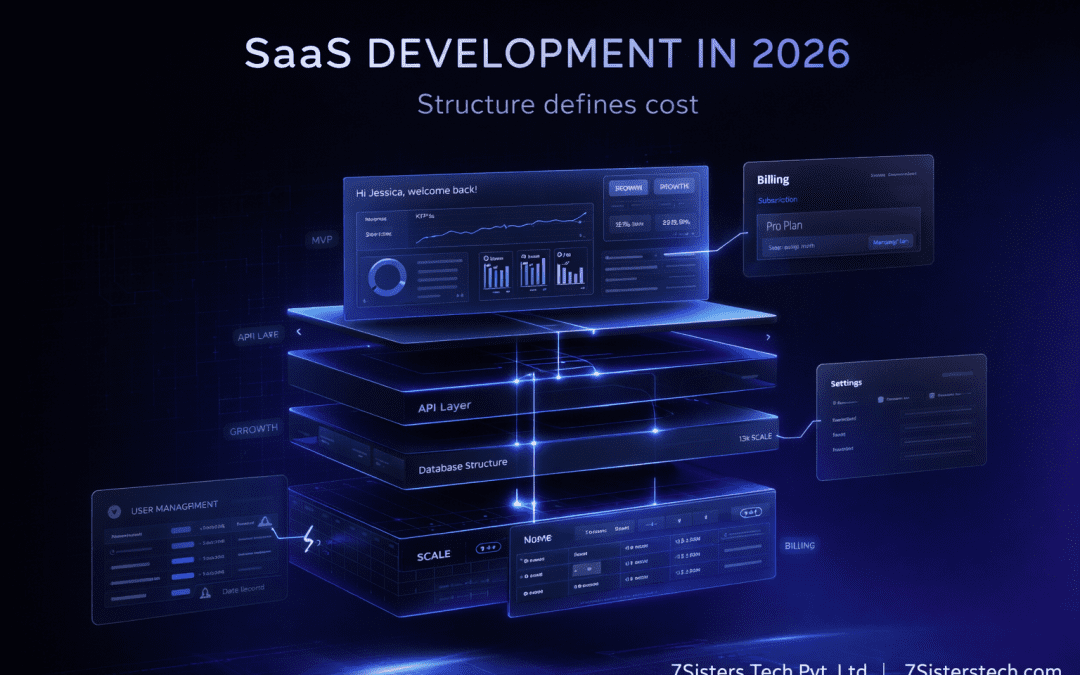
If you are a startup founder, product manager, or business owner trying to build a SaaS product in 2026, you need real numbers. Numbers grounded in what US startups are actually spending right now – not theoretical estimates from a sales deck.
This article gives you exactly that.
We have worked with founders across the US who have built everything from lean two-feature MVPs to enterprise-grade SaaS platforms. The numbers in this guide come from real projects, real invoices, and real conversations with people who have already been through this process.
By the time you finish reading, you will know what your SaaS product is likely to cost, what drives that number up or down, what most founders forget to budget for, and how to choose the right development partner for your specific situation.
The global SaaS market is on track to surpass $340 billion in 2026. The opportunity is real. But so is the risk of starting without a clear financial picture. Let us fix that right now.
SaaS Development Cost at a Glance: 2026 Quick Reference
Before we go deep, here is the honest summary that most cost guides bury at the bottom.
A basic SaaS MVP – the kind that tests one core idea with real users — costs between $15,000 and $40,000 in 2026. This is not a polished product. It is a production-ready prototype focused on one workflow, minimal integrations, and just enough design to be usable.
A mid-scale SaaS product with polished dashboards, multiple user roles, a billing system, and a handful of integrations runs between $40,000 and $150,000. This is where most seed-stage US startups land when they are building their first real market-facing product.
A full-featured SaaS platform – the kind that competes directly with established tools, includes automation, deep reporting, advanced user management, and a genuinely great user experience across every screen – costs between $150,000 and $350,000.
Enterprise SaaS platforms that require compliance (HIPAA, SOC2, PCI-DSS), high availability infrastructure, AI features, complex integrations, and custom security architecture start at $350,000 and can exceed $1 million depending on scope.
Most US founders building their first SaaS product spend somewhere between $25,000 and $100,000. That is the real market center. Everything outside that range exists for a reason and understanding those reasons is what the rest of this article is about.
What Actually Drives SaaS Development Cost: The 7 Real Factors
Two SaaS products can look identical on the surface and have development costs that are $80,000 apart. Here is why.
Product Complexity and Feature Scope
The single biggest cost driver is what you are building. A simple SaaS tool with basic user authentication, a clean dashboard, and one core workflow is fundamentally different from a platform that includes multi-tenancy, role-based access control, automated workflows, reporting modules, and real-time data processing.
Every feature you add costs time. Furthermore, each edge case a developer handles adds hours to the estimate. Every screen a designer has to think through carries its own cost.
A common mistake US founders make is writing down a feature list without understanding that “add payment processing” and “add Stripe subscriptions with metered billing, trial periods, and proration logic” are not the same thing — and they do not cost the same thing.
The discipline of scoping carefully before you build is worth more than almost any other decision you will make.
Tech Stack Selection
The technology your product is built on affects both the initial development cost and the long-term maintenance cost. A React and Node.js stack is well-documented, has a huge talent pool, and is battle-tested for SaaS products. Choosing a niche or experimental framework can reduce your initial options while significantly increasing the hourly rate of the developers who can work on it.
In 2026, most well-built SaaS products use React or Next.js on the frontend, Node.js or Python on the backend, PostgreSQL or a managed cloud database, and AWS or Google Cloud for infrastructure.
This stack is not exciting. It is boring in the best possible way – reliable, scalable, and easy to find experienced developers for.
US Developers vs Offshore Development Teams
This is the factor that moves the cost needle more than almost anything else. Experienced developers in the United States charge between $100 and $200 per hour in 2026. Senior engineers with deep SaaS architecture experience charge even more.
Now imagine a SaaS product that requires 1,200 development hours. At $130 per hour with a US team, that is $156,000 in development cost alone – and that figure excludes design, QA, DevOps, and project management entirely.
By contrast, a skilled offshore development team working on the same project at $35 to $75 per hour delivers those same 1,200 hours for $42,000 to $90,000. The savings are real. However, the risk is equally real if you choose based on price alone.
The difference between a strong offshore partner and a cheap one is not the hourly rate. It is the discovery process, communication discipline, SaaS-specific experience, and architecture quality. We will come back to how to evaluate this properly.
Third-Party Integrations
Every integration your SaaS product needs with an external service adds cost. Not a little cost – real cost.
Stripe for subscription billing is not just flipping a switch. Proper Stripe integration with support for monthly and annual billing, trial periods, seat-based pricing, upgrade and downgrade logic, and webhook handling for failed payments is a genuine engineering project that costs $3,000 to $8,000 on its own.
The same applies to Twilio for SMS, SendGrid for transactional email, HubSpot or Salesforce for CRM sync, Zapier or Make for automation, and any other external service. Most SaaS products need three to six integrations at launch. Budget $2,000 to $10,000 per integration depending on complexity.
UI/UX Design Quality
There is a significant difference between “functional design” and “great design.” Functional design means users can figure out how to use the product. Great design means users want to keep using the product.
For an early MVP, functional design is often the right call. It costs $3,000 to $8,000 and gets the job done. For a product launching into a competitive market where you are asking people to pay $49 to $299 per month, investing $10,000 to $20,000 in design pays for itself in conversion rate and churn reduction.
US SaaS buyers have been raised on Notion, Linear, and Stripe’s dashboard. Their standards are high. Design is not decoration — it is your first sales pitch.
Compliance Requirements
If your SaaS serves the healthcare market, you need HIPAA compliance. If you handle payment data, you need PCI-DSS. If you have European users, you need GDPR. If you are selling to enterprise customers, they will likely ask for SOC 2.
None of these are free. HIPAA-compliant architecture, audit logging, encrypted data storage, and business associate agreements add 20 to 35 percent to your base development cost. Plan for it early – retrofitting compliance into a non-compliant architecture is one of the most expensive software mistakes a US startup can make.
The Discovery Phase
This one surprises founders. A proper discovery phase – where a development team maps your product requirements, defines the architecture, creates wireframes, and produces a detailed technical specification costs $3,000 to $10,000 and takes two to four weeks.
Skipping it to save money is one of the most expensive decisions you can make. Discovery prevents scope creep, catches architectural mistakes before they become structural problems, and gives you a real cost estimate instead of a guess. Industry data consistently shows that discovery prevents rework that costs three times its price. Every dollar spent in discovery saves three in development.
Where the Budget Goes: A Component-by-Component Breakdown
When a development partner quotes you a number, it reflects the sum of these distinct work areas. Understanding each one helps you have smarter conversations and catch gaps in proposals.
UI/UX design – wireframes, user flows, visual design, and interactive prototypes – typically represents 10 to 15 percent of the total project budget. For a $60,000 project, expect $6,000 to $9,000 in design work. Rushing this phase is where most bad user experiences are born.
Frontend development – everything the user sees and interacts with, including dashboards, forms, tables, settings screens, mobile responsiveness, and performance optimization – represents 15 to 20 percent of the budget.
Backend development – the APIs, business logic, authentication system, database architecture, billing infrastructure, and all the code that makes your product actually do something – is the largest single cost driver. It represents 35 to 45 percent of a typical SaaS development budget. This is where complexity compounds. Every additional feature, every edge case, every integration shows up here.
DevOps and cloud infrastructure setting up your hosting environment, CI/CD pipelines, staging and production environments, deployment automation, and monitoring represents 8 to 12 percent. Do not skip this. A product without proper infrastructure is one traffic spike away from an outage.
Quality assurance and testing – manual testing, regression testing, bug fixes, and sometimes automated test suites – represents 10 to 15 percent of the budget. Founders who cut QA always pay more in post-launch emergency fixes than they saved.
Post-launch maintenance is not a one-time cost. Budget 15 to 25 percent of your original development investment every year for ongoing maintenance. A $60,000 SaaS product costs $9,000 to $15,000 per year just to keep it secure, performant, and current with evolving third-party APIs.
These figures reflect market averages across multiple 2026 industry reports. Your actual cost will vary based on your specific requirements, team location, and product complexity.
Real Numbers: What US Startups Are Actually Spending in 2026
Theory is one thing. Here is what we see in practice across three common founder situations.
The bootstrapped founder with $30,000 to $60,000 to spend is building a lean MVP targeting one very specific user problem. They choose an offshore dedicated team, build in 8 to 12 weeks, launch with minimal features, and use real user feedback to decide what to build next.
Importantly, This approach works when the scope is disciplined and the development partner has genuine SaaS experience. Many successful SaaS companies started here.
The seed-funded startup with $150,000 to $300,000 raised is ready to build a product that competes in the market. They typically allocate $60,000 to $120,000 for the initial product build, invest properly in design, include core integrations, and plan for a 4 to 6 month timeline. As a result, the remaining budget covers cloud costs, marketing, and the first few months of post-launch iteration.
The Series A company with $1 million or more raised is building an enterprise-ready platform. They need compliance, advanced security, AI-powered features, complex reporting, and the kind of infrastructure that can handle thousands of concurrent users. Development budgets at this stage commonly run $250,000 to $500,000 or more, with multi-phase delivery over 10 to 18 months.
One number to keep in mind: research consistently shows that 70 percent of SaaS founders exceed their initial development budget. The primary culprit is not developer incompetence. It is scope that grows during the project without a corresponding adjustment to the budget or timeline. This is one of the most powerful arguments for a thorough discovery phase and a clear, signed statement of work before development begins.
Hidden SaaS Costs That US Founders Forget to Budget For
The development invoice is only part of what building a SaaS product costs. These are the line items that catch founders off guard.
Third-party service fees compound quickly. Stripe charges 2.9 percent plus $0.30 on every transaction.
Additionally, tools like SendGrid, Postmark, Datadog, Sentry, Intercom, and HubSpot each carry their own monthly cost. By the time your SaaS product is live and growing, you are often paying $500 to $3,000 per month in tool subscriptions alone — before you have significant revenue.
Cloud infrastructure grows with your product. Early-stage SaaS products typically spend $500 to $2,000 per month on AWS or Google Cloud. That number scales significantly as your user base grows, your data volume increases, and your infrastructure requirements become more complex.
Customer acquisition is a cost that founders consistently underestimate. Research from 2026 market data puts the average cost to acquire a quality SaaS user in the US at $50 to $200 or more. Plan to spend $5,000 to $15,000 in your first launch month just to get enough users to validate your core assumptions. Therefore, building a great product does not generate users automatically.
Legal and compliance costs – privacy policies, terms of service, GDPR compliance frameworks, security audits, and any industry-specific certifications, add $2,000 to $15,000 depending on your market.
Annual maintenance, already mentioned above at 15 to 25 percent of your build cost per year, is the one most founders intellectually acknowledge but fail to actually set aside money for. Consequently, do not make this mistake.
How to Choose the Right Development Partner for Your Budget
The development team you choose affects not just your cost but your outcome. Here is an honest comparison of the three main options US founders work with.
Building an in-house engineering team is the right choice when you have consistent, long-term development needs, significant runway, and the time to recruit properly. In 2026, a full-time senior software engineer in the US commands $130,000 to $190,000 in annual salary. A three-person team – one backend engineer, one frontend engineer, and one designer – costs $400,000 to $580,000 in salary alone before benefits, equipment, recruitment fees, and management overhead. In short, this is a Series A or Series B decision, not a pre-launch one.
Freelancers are a reasonable option for small, well-defined pieces of work. However, they are a poor choice for building an entire SaaS product. Coordination challenges, inconsistent code quality, and zero accountability make them a risky foundation for a startup launch.
A dedicated offshore development team gives you a structured team – typically a tech lead, one or two developers, a designer, and a QA engineer – that works exclusively on your product. The cost advantage is 50 to 70 percent compared to equivalent US rates. The risk is that not all offshore teams are equal. In practice, the difference between a strong offshore partner and a disappointing one is almost always visible before you sign: do they run a discovery phase, do they ask hard questions about your
requirements, do they have a SaaS-specific portfolio, and do they communicate in a way that builds confidence?
When evaluating any development partner, ask to see SaaS products they have built that are live and paying customers. Ask how they handle scope changes. Ask what their process is when they discover that a requirement is more complex than initially estimated. Ultimately, the answers tell you more than any proposal document.
Frequently Asked Questions About SaaS Development Cost
How much does it cost to build a SaaS product from scratch in 2026?
SaaS development in 2026 costs between $15,000 for a basic MVP and $500,000 or more for an enterprise-grade platform. Most early-stage US startups build their first SaaS product in the $25,000 to $100,000 range, depending on features, integrations, and team location.
What is a realistic budget for a SaaS MVP?
A realistic SaaS MVP budget in 2026 is $15,000 to $40,000. This covers core authentication, a basic dashboard, one primary workflow, and minimal integrations. Very simple products may come in slightly under. Feature-heavy MVPs with multiple user types or complex data logic will exceed this range.
Is it cheaper to outsource SaaS development than build in-house?
For most early and growth-stage startups, yes. A US in-house engineering team costs $400,000 or more per year in salaries before overhead. A dedicated offshore development team delivering the same quality at $35 to $75 per hour costs a fraction of that. Outsourcing makes financial sense until you have consistent long-term development needs that justify the full cost of in-house hiring.
How long does SaaS development take?
A basic SaaS MVP takes 8 to 12 weeks. A mid-scale product with polished design and integrations takes 4 to 6 months. A full-featured enterprise SaaS platform takes 10 to 18 months or more depending on scope. These timelines assume a clear specification exists at the start of development. Discovery and planning add 2 to 4 weeks before this clock starts.
What hidden costs should I plan for beyond development?
Plan for cloud infrastructure ($500 to $2,000 per month), third-party tool subscriptions ($500 to $3,000 per month), annual maintenance (15 to 25 percent of your build cost), customer acquisition costs for launch ($5,000 to $15,000 minimum), and any compliance or legal requirements specific to your industry.
How much does SaaS maintenance cost annually?
Annual SaaS maintenance costs 15 to 25 percent of your original development investment. A product that cost $60,000 to build costs $9,000 to $15,000 per year to maintain, update, and keep secure. This covers bug fixes, security patches, dependency updates, and small feature improvements. It does not cover major new feature development.
Getting Your Real Number
Reading about SaaS development costs is useful. Getting a number that is specific to your product, your feature requirements, your market, and your timeline is what actually lets you make a decision.
The ranges in this article are real. But your product is specific. A 30-minute conversation about what you are building, who it is for, and what it needs to do on day one is what turns a range into a real budget.
If you are serious about building a SaaS product in 2026 and want an honest, no-fluff estimate for your specific idea, we offer a free scoping call. No sales pitch. Just a structured conversation that ends with a realistic number you can actually plan around.
Book your free 30-minute SaaS scoping call – and get a written cost estimate within 48 hours.
Best Related Blog Titles
HIPAA-compliant app development: what US healthcare startups must know before building
Disclaimer: This article is for informational and educational purposes only. It does not constitute legal, compliance, or professional advice. HIPAA...

AI Features That Actually Improve User Experience in Mobile Apps (2026 Guide)
Artificial Intelligence is no longer just a buzzword in mobile app development. Businesses across the USA, UK, and Canada are integrating AI...

How Mobile Apps Improve Field Operations and Workforce Productivity
Businesses across the USA and Europe are rapidly adopting custom mobile applications to streamline field operations, manage remote teams, and...